Terraform for coding agents.
The missing primitive for multi-agent topologies.
One YAML file. One command. The whole fleet boots.
Persistent identity. Shared memory. Reboot, restore, keep going.
Claude Code and Codex in the same topology. Open source. No API keys.
$ rig up demo/rig.yaml Resolving AgentSpecs... ✓ Launching 4 pods, 8 nodes... orch-lead@demo ● READY claude-code orch-peer@demo ● READY codex dev-impl@demo ● READY claude-code dev-qa@demo ● READY codex dev-design@demo ● READY claude-code rev-r1@demo ● READY claude-code rev-r2@demo ● READY codex infra-server@demo ● READY terminal Topology ready. 8 nodes across 4 pods. Dashboard: http://localhost:7433/rigs/abc123 Orchestrator: tmux attach -t orch-lead@demo
What's a rig?
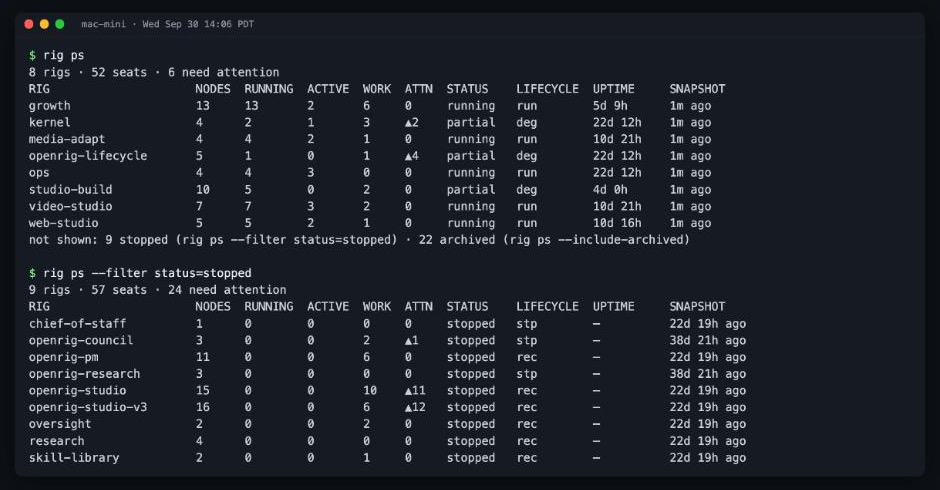
A rig is a topology of coding agents working together — defined in YAML, booted with one command, managed as a single unit. Agents are grouped into pods that share context. Pods are connected by edges that define how they communicate. The whole thing snapshots, restores, and survives reboots.
Full walkthroughExample —
The Product Team
Agents that can live forever. Knowledge that compounds across sessions. Distributed context management across an entire topology — not just one agent, but a fleet. The Product Team ships agents that remember last week's decisions, maintain context across reboots, and keep working while you sleep.
No more onboarding fresh agents every morning. No more re-explaining what you already decided. These are durable entities — the same team, for weeks or months, shipping production software. This is what becomes easy to build when you have OpenRig. And this is just the surface.
Persistent identity
Sessions end. The agent doesn't. Same name, same role, same knowledge. When a context window fills, the agent transfers to a fresh session.
Shared memory
Agents in a pod share externalized state. When one compacts, the others restore it. Context survives across the entire topology.
One interface
The orchestrator coordinates the fleet. One conversation manages the whole topology. Check in from your phone.
$ rig up demo/rig.yaml Resolving AgentSpecs... ✓ Launching 4 pods, 8 nodes... orch-lead@demo ● READY claude-code orch-peer@demo ● READY codex dev-impl@demo ● READY claude-code dev-qa@demo ● READY codex dev-design@demo ● READY claude-code rev-r1@demo ● READY claude-code rev-r2@demo ● READY codex infra-server@demo ● READY terminal Topology ready. 8 nodes across 4 pods.
50 lines of YAML. Here's what else people are building:
Full Product Team
10 agents · 4 podsOrchestrator HA pair, development pod, review pod, research pod. The topology that ships with OpenRig.
Adversarial Review
2 agents · 1 podClaude and Codex review every PR from different angles. Different models catch different bugs.
Research Cluster
4 agents · 1 podFour agents exploring the same problem. Peer-to-peer, no hierarchy. Shared knowledge base.
Security Hardening
6 agents · 3 podsAttack pod probes. Defense pod patches. Observer pod writes a dossier. Iterate until clean.
Continuous Refactor
5 agents · 2 podsRefactoring pod improves code. Review pod catches regressions. Runs overnight.
Secrets Manager
1 agent · 1 podAn always-on agent that operates Bitwarden for you. Agent managed software — the agent runs the tool so you don't have to.
Your Idea Here
? agents · ? podsPoint your agent at the docs and describe what you want. It writes the RigSpec for you.
One command.
Install the CLI. Tell your agent to start OpenRig and bring up the demo topology. Or skip the agent and run it yourself.
Already have agents running in tmux? rig discover fingerprints your existing sessions and drafts a candidate RigSpec.
npm install -g @openrig/cli # Tell your agent: "Start OpenRig and bring up the demo topology." rig up demo/rig.yaml